
You have 17 competitor tabs open. Four of them you opened yesterday and forgot why. Your "research" is a Google Doc with three bullet points, a screenshot of a pricing page, and a Reddit thread you keep meaning to read. Somewhere in this mess is the answer to "should I build this?" — but you can't see it, because it isn't anywhere. It's scattered across your browser, your notes app, and your head.
That's how most solo founders and early-stage product people actually do research: skim a few sites, scroll a forum, jot a sticky note, then make a real decision on incomplete, disorganized information. CB Insights found that 35% of startups fail because there was no market need for the product. Not because the founder didn't work hard — because the research never became a system they could reason over.
The fix isn't a bigger team. It's a framework plus a tool that does the assembling for you. The framework is RISE — Research, Interpret, Structure, Execute. The tool is Dotallio, where you describe the research system you want and it builds it.
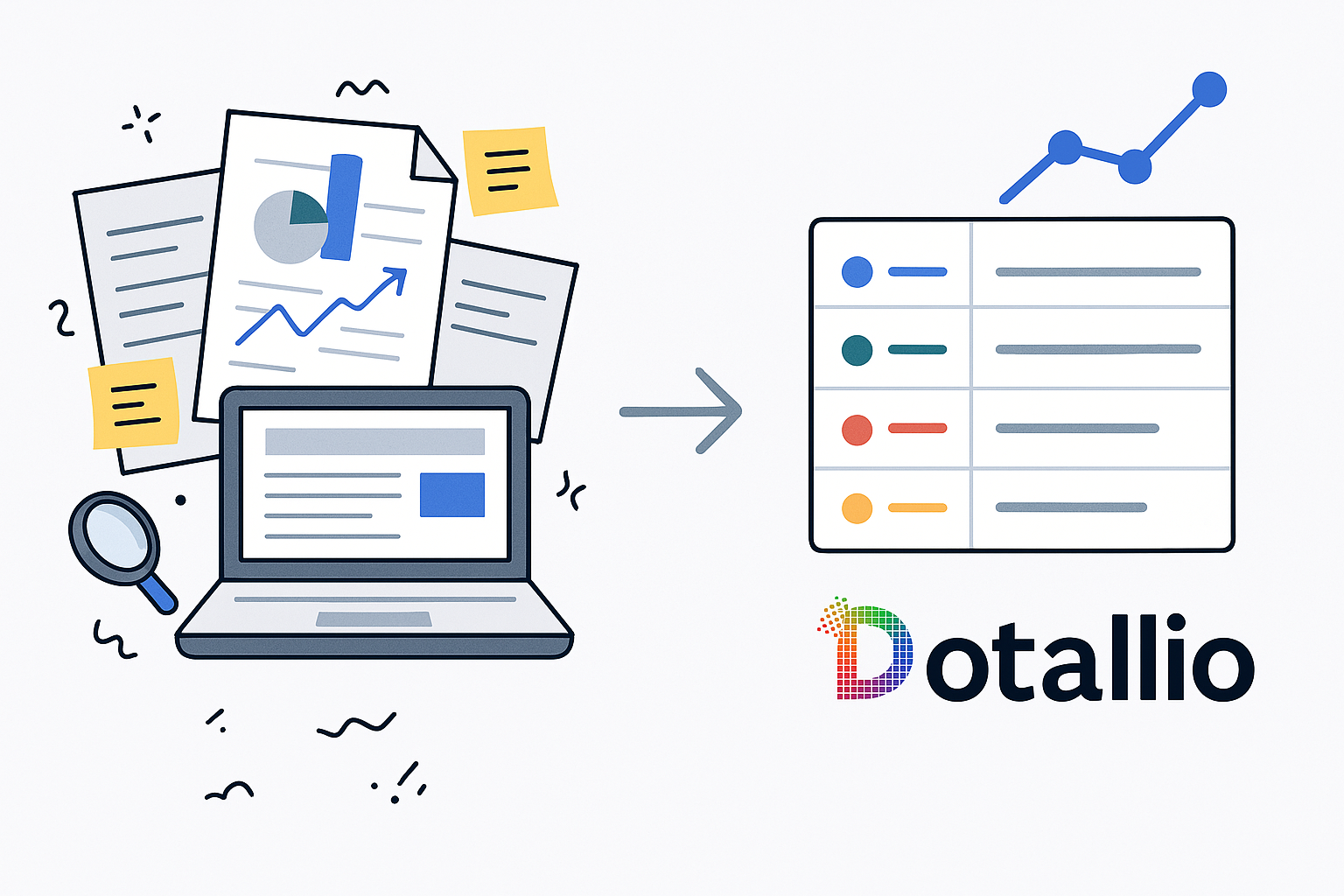
You don't build the research system. You describe it.
The old Dotallio made you build the board yourself — add a column, pick a type, set up a view, repeat. The new Dotallio is chat-first. You write one sentence describing what you're trying to learn, and it assembles the whole thing: the board, the right columns, sensible sample rows, and the views you'll actually use.
And everything it produces is an artifact — a versionable, editable deliverable. The competitor table, the research brief, the comparison chart: each one you can refine, roll back to an earlier version, and share by private link or with your whole workspace. Your research stops being a pile of tabs and becomes a living workspace that gets sharper every time you touch it.
Here's RISE, run as a real Dotallio session.
Research: gather with intention, not 17 tabs
Don't start by browsing. Start by telling Dotallio what you want to track.
Create a competitive intelligence board for project management tools aimed at freelancers. Columns for company, positioning, pricing tiers, core features, target user, standout weakness, and a link to their site. Add 8 real competitors as sample rows.
Dotallio builds the board, picks the column types (text, link, number for price, a multi-select for features), and fills in starter rows so you're not staring at an empty grid. That's your skeleton — built from one sentence instead of twenty minutes of clicking.
Now turn on a Smart Workflow to do the actual digging:
Run web research on each competitor in this board and fill in their pricing, three standout features, and their most common complaint from reviews. Add a source link for each finding.
At the higher "smart" levels, Dotallio plans the work — research, then generate, then write back — runs live web research, and enriches the rows in bulk, filling whole columns across every competitor at once. You kick it off on demand. While it works, you go make coffee. You come back to a populated table instead of a to-do list.
Drowning in raw material already? Drop it in. Paste a messy block of notes, upload a PDF analyst report, or snap a photo of a whiteboard from your last strategy session — Dotallio's vision OCR reads the photo and structures what's on it into rows you can actually query.
Interpret: find the pattern, not just the facts
A full table is still noise until someone reads it. This is where you'd normally stall. Instead, @-mention the board into a chat and ask:
@board:Competitive Intelligence — across all these competitors, what are the three most common complaints, and where's the biggest gap nobody is filling for freelancers?
The chat pulls the board in as context and answers from your real data — not a generic web summary. It surfaces the recurring "too complicated for one person" complaint, the pricing cliff between the free tier and the cheapest paid plan, and the fact that none of them handle invoicing. That answer comes back as a doc artifact you can keep, edit, and link to your board.
Want to see it instead of read it? Ask for a chart:
Turn the complaint counts into a pie chart and the feature coverage into a comparison I can show in a pitch.
Dotallio generates a chart artifact (pie, flow, sequence, or gantt via Mermaid) you can drop into a deck or a doc. The pattern you couldn't see in 17 tabs is now one glanceable image.
Structure: clarity, not ten different files
Your insights shouldn't live in ten places, and with a chat-first workspace they don't have to. Everything you generate lands as a structured artifact in one workspace — the competitor board, the gap-analysis doc, the chart, the validation survey. They're connected, searchable, and consistent.
Need a different cut of the same data? Don't rebuild it.
Add a formula column that flags any competitor priced under $10/month, and a conditional format that highlights anyone missing invoicing.
Dotallio writes the formula in Google Sheets syntax (IF, COUNTIF, and friends), applies the conditional formatting, and you've got a fresh lens on the data you already have. Twenty-plus column types, linked records, sub-items, type-aware filters, and CSV/Excel import-export mean the structure bends to your question instead of the other way around.
Execute: act on what you found, not what you assumed
Research is wasted if it dies in a tab. Turn the gap you found into a move.
Based on the invoicing gap in my competitive board, draft an MVP brief and five customer-interview questions to validate that freelancers actually want invoicing built into a PM tool.
Out comes an editable doc artifact: the brief, the hypotheses, the interview script. Edit it, version it, set it to a public link, and send it to the three freelancers you know. When their answers come back, you can paste them straight into a new board and ask Dotallio what changed your mind.
If you'd rather build a proper deck for an investor or advisor, draft the story in chat, then build and refine it in the presentation editor — AI helps with speaker notes, copy rewrites, generated slide images, and smart layouts. You shape the narrative; Dotallio does the heavy lifting on the slides.
Keeping it alive
The real win isn't the first pass. It's that your research system stays useful after week one.
- AI columns keep filling new rows as you add competitors, so the board never goes stale.
- Smart Workflows can be re-run on demand, fired by a board event, or triggered by a button or an incoming webhook — so when a competitor changes pricing and you log it, your enrichment kicks off again.
- Versioned artifacts mean last month's gap analysis is still there next to this month's. You can watch the market move instead of guessing whether it did.
- Web research and enrichment refresh the facts on command, so your "current state" is actually current when you're about to make a call.
It's a research system you maintain by talking to it, not by rebuilding spreadsheets.
A real-life payoff
Maya is a solo founder validating a freelancer-focused PM tool. Friday afternoon, she types one sentence and gets a competitive board. She runs a Smart Workflow over the weekend's coffee; by the time the mug's empty, eight competitors are enriched with pricing, features, and complaints, each with a source link. She @-mentions the board, gets a gap-analysis doc, and turns it into a pie chart. Monday she drafts an MVP brief and five interview questions, sets the doc to a public link, and sends it to five freelancers. By Wednesday she has answers — and a structured place to put them. Total manual setup time: roughly the length of one sentence, four times.
Why this is better
- You describe it, Dotallio builds it — the board, columns, and views come from one sentence, not an hour of setup.
- Live web research and bulk enrichment do the tab-grinding for you, on demand.
- Everything is a versionable artifact — docs, tables, charts — you can edit, roll back, and share.
- @-mention your own data so the AI reasons over your real research, not a generic web answer.
- Formulas, filters, and conditional formatting reshape your findings without a rebuild.
- One workspace instead of 17 tabs, a notes app, and your memory.
Stop letting research overwhelm you and start treating it as the edge it is. Describe the research system you wish you had, let Dotallio assemble it, then keep it alive by talking to it. Dot will be there to help you find your way.