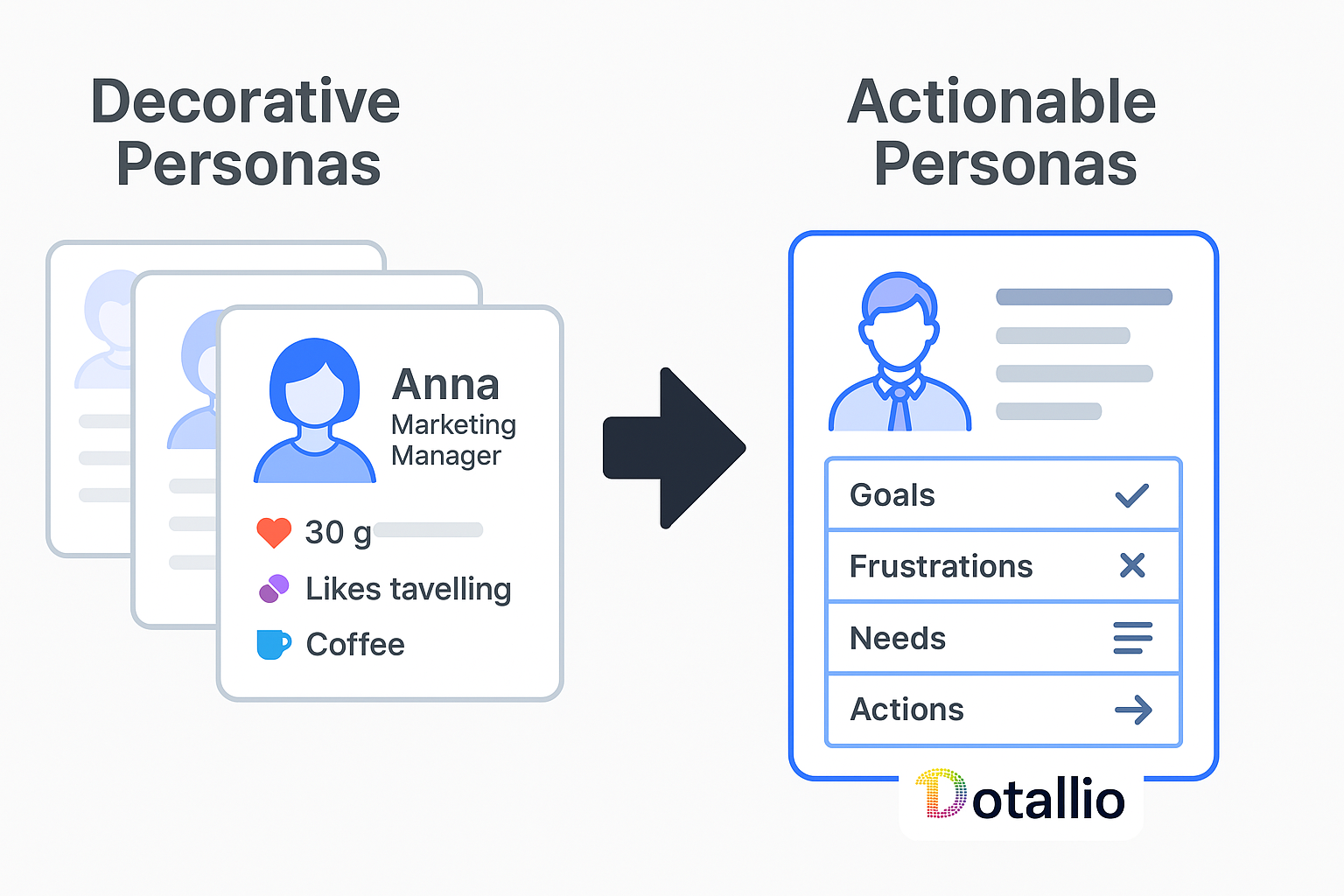
You ran the interviews. You sent the survey. You sat with the support tickets. Then you spent an afternoon in a design tool making three handsome persona cards — "Marketing Mary, 35, loves dogs, drinks oat-milk lattes" — and pinned them to a board.
When did you last open them? Be honest. They look great in a deck and do nothing on a Tuesday when you're deciding which feature to build or which email angle to test.
You're not the problem. The format is. A Nielsen Norman Group review found that while most teams create personas, only a small minority feel those personas actually influence decisions. The rest become expensive wallpaper — a snapshot of who your users are, with zero hint of what to do about it.
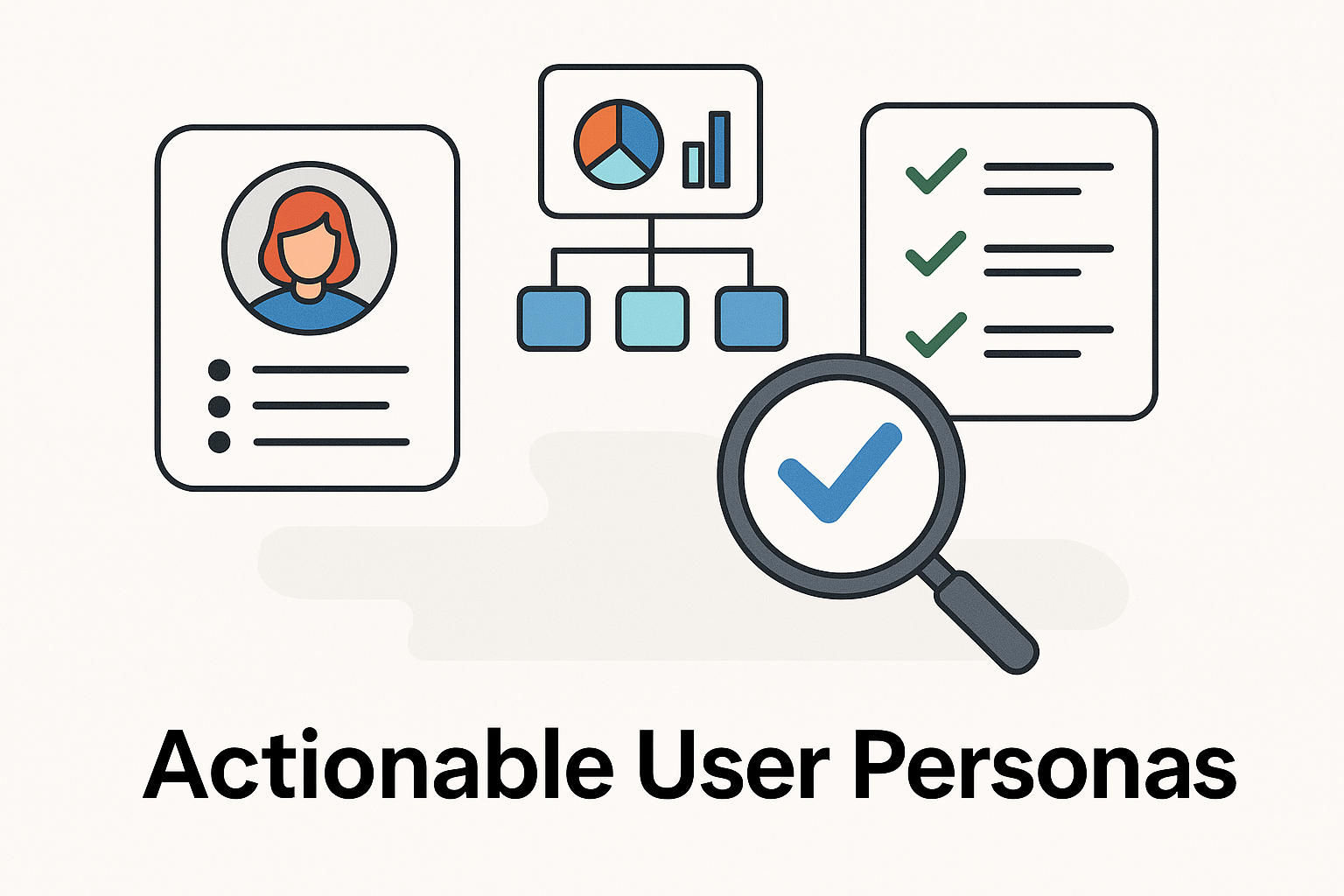
The fix isn't a prettier template. It's a different kind of artifact: a persona you can filter, score against, and feed straight into a feature checklist. One that updates as your research grows instead of freezing the day you made it.
You don't build it. You describe it.
Here's the shift. The old way had you manually building a board, naming every column, and hand-sorting quotes into buckets before you even started thinking. By the time the structure existed, the energy was gone.
In Dotallio, you skip the construction. You describe what you want in plain language and Dotallio assembles it — the board, the columns, the sample rows, the right views. You drop in your raw material — interview transcripts, a survey CSV, a screenshot of a Slack thread, messy notes — and it reads and structures them for you.
Everything it produces is a versionable, editable artifact. The persona board, the synthesis doc, the prioritization checklist — you can refine any of them, roll back a version, and share them with your team. You describe it once, then keep it alive.
A real session: from raw notes to a persona engine
Let's build a persona system the way you'd actually do it in Dotallio — by typing, not by clicking through column settings.
Start with the structure. Open a chat and describe the board you want:
Create a "User Personas" board for my project-management SaaS. Columns for persona name, the job they're trying to get done, key decision criteria, what trade-offs they accept, their behavioral segment, the scenario where they decide, and the stakeholders who influence them. Add 3 sample personas so I can see the shape.
Dotallio creates the board, picks sensible column types (a select for behavioral segment, long-text for jobs-to-be-done, linked records for stakeholders), and seeds three example rows. No setup screen. You're looking at a working board in seconds.
Now feed it your real research. Paste a transcript straight into the chat:
Here are notes from five user interviews. Pull out each person's job-to-be-done, the decision criteria they actually mentioned, the trade-offs they said they'd accept, and which scenario they were in when they chose a tool. Fill the board with what you find — don't invent details that aren't in the notes.
The AI reads your text, extracts the patterns, and populates rows grounded in what people actually said. The synthesis lands as an editable doc artifact alongside the board, so you can see why it tagged each person the way it did and correct anything that's off.
Group by behavior, not job title. Demographics don't predict what people do. Behavior does:
Look across all the personas and group them by how they actually behave with a tool like mine — not by company size. Add a "Behavioral Segment" value to each row and tell me what defines each group.
Dotallio fills a whole column at once and you get segments that map to action — "Quick-Win Seeker," "Power Customizer," "Data Extractor," "Occasional Checker" — each defined by goals and habits instead of a label that tells you nothing.
Turn it into a tool you'll use. Insight you can't act on is just trivia:
Generate a feature-prioritization checklist as a doc. For each behavioral segment, list the questions I should ask before shipping anything, scored against that segment's decision criteria. Then write user-story templates for the Quick-Win Seeker in the "first 10 minutes" scenario.
Now you have a doc artifact you actually open during sprint planning — a scorecard that turns "should we build this?" into a short, answerable list.
Keeping it alive with web research and AI columns
A persona made once and never touched is the original sin. Dotallio's job is to keep the engine current.
Enrich rows with live research. Run a Smart Workflow over your board and the AI plans the work, does live web research, and fills the gaps:
For each persona's industry, research current trends and the top three tools they're comparing us against right now. Add a "Competitive Context" column and fill it in with sources.
At the "smart" levels, Dotallio plans multi-step work — research, then generate, then write back to the right rows — and fills the whole column in bulk. You can trigger this on demand, from a button on the board, when a new persona row gets added, or from an incoming webhook when your survey tool drops new responses. (It runs when something kicks it off, not silently overnight — you stay in the loop.)
Let AI-filled columns do the synthesis. Add a column and describe what it should contain — "summarize this persona's biggest unmet need in one sentence" — and every row fills itself from the data already there. New interviews come in, you paste them, and the columns update.
Keep the formulas honest. Score and flag with plain spreadsheet syntax. A COUNTIF over your interview notes counts how many people raised a given objection; an IF flags any segment with thin evidence so you know where to research next. Same Google Sheets functions you already know.
Every version is recoverable. Because each artifact is version-controlled, you can compare the persona doc from last quarter against today's, roll back a bad AI rewrite, and set visibility — private while it's rough, workspace-wide once it's solid, or a public link to share with a client.
What this looks like in practice
You're a solo founder validating a B2B tool. Friday afternoon, you dump ten interview transcripts and a survey export into a Dotallio chat and ask it to build a persona board and fill it from the data. Twenty minutes later you have four behavioral segments, each with real decision criteria pulled from real quotes.
You notice the IT-evaluator stakeholder keeps appearing as a blocker, so you ask Dotallio to research what security questions tools in your category typically get asked. It runs the search, writes the answers into a "Security Objections" column with sources, and drafts a one-page FAQ doc you can hand to prospects.
Monday, in sprint planning, you open the prioritization checklist it generated. The feature you were excited about scores poorly for your largest segment — the Quick-Win Seeker — so you swap it for a faster onboarding flow instead. The persona didn't sit in a folder. It changed what you built.
Why this is better
- No manual setup. You describe the persona system; Dotallio builds the board, columns, and starter data.
- It reads your mess. Transcripts, survey CSVs, screenshots, scattered notes — drop them in and get structure back.
- Grounded, not confabulated. Synthesis is pulled from your actual data, shown as an editable doc you can correct.
- Action, not decoration. Behavioral segments, decision criteria, and generated checklists feed straight into your roadmap.
- It stays current. Smart Workflows run live web research and enrich rows on demand or on a board event.
- Everything is a living artifact. Version every doc and board, roll back, and control who sees what.
Stop building wallpaper
Personas fail when they're a one-time art project. They work when they're a living system you can query, score against, and update — and when getting there takes a paragraph of plain English instead of an afternoon of column-wrangling.
Describe the persona engine you wish you had. Drop in the research you already collected. Let Dotallio assemble it and keep it alive while you go make decisions.