You spent eleven weeks building the wrong thing. The login flow was solid. The settings page had three tabs nobody asked for. The dashboard rendered in 200ms. And on launch day, the people you built it for shrugged and went back to their spreadsheet.
This is the classic MVP trap: you build what's easy to build, not what's valuable to use. Convenience drives the scope. The river you actually needed to cross is two miles east of the bridge you finished.
CB Insights' post-mortem analysis of failed startups found that "no market need" is the most-cited reason founders give for failure — the single largest bucket in their teardown. Translation: the most common way to lose is to ship something well-made that nobody wanted. The fix isn't building faster. It's deciding better, before you write a line of code — and then keeping that decision honest as you go.
You don't build the plan. You describe it.
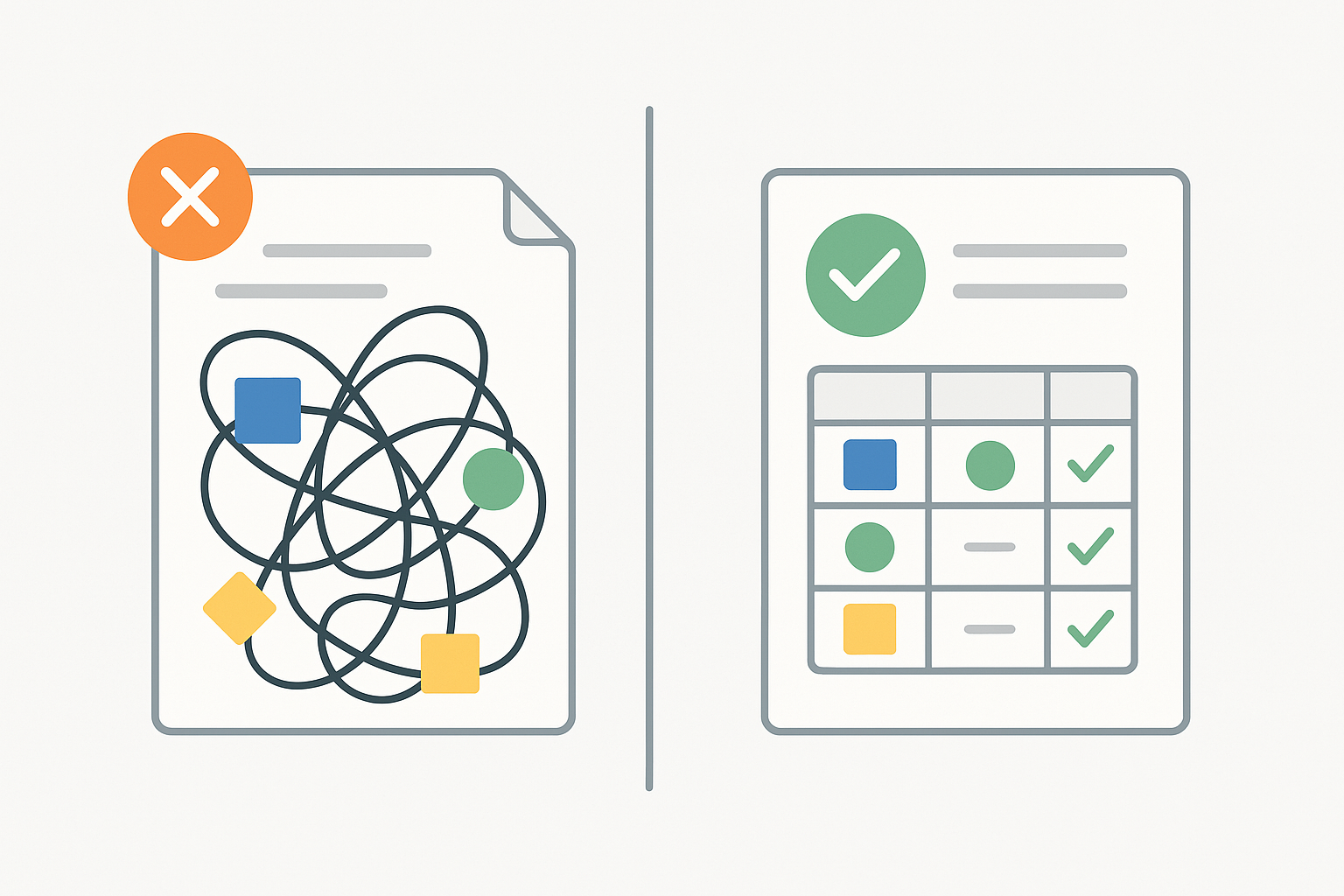
The old way of scoping an MVP was a graveyard of documents: a Notion page for the value hypothesis, a spreadsheet for the feature matrix, a Miro board for user flows, a Google Doc for interview notes, and a Slack thread arguing about all of it. By the time you reconciled them, the assumptions were stale.
Dotallio is chat-first. You describe the product you're trying to scope in plain language, and Dotallio assembles the actual artifacts — a prioritization board, a hypothesis doc, a research sheet, a one-pager for the team. Drop in your messy founder notes, a voice-memo transcript, a screenshot of a competitor, a stack of customer-call PDFs, and it structures them for you. No columns to configure. No templates to wire up.
And everything it produces is a real, editable, version-controlled artifact. When your understanding of the customer changes in week three — and it will — you don't rebuild the board. You tell Dotallio what changed and refine the version that already exists.
A real scoping session
Here's what defining the right MVP actually looks like when you stop building documents by hand.
Start with the raw idea and let it become a board.
Create a feature-prioritization board for my MVP. The product is a tool that helps freelance designers send branded invoices and chase late payments. Add columns for feature name, the customer job it serves, value to the user (1–5), build effort (S/M/L), and an "In MVP?" toggle. Seed it with the 12 features a tool like this would plausibly need.
Dotallio creates the board with the right column types — a select for effort, a rating column for value, a checkbox for the MVP toggle — and fills in twelve real candidate features with first-pass estimates. You're not staring at an empty grid; you're editing a draft that already argues with you.
Turn convenience-thinking into value-thinking with a formula.
Add a "Priority Score" column using a formula: value times 4, minus effort weighted (S=1, M=2, L=3). Sort highest first.
The board now ranks features by user value adjusted for cost — in Google Sheets formula syntax you can read and tweak — so the easy-but-pointless features sink and the hard-but-essential ones surface. The "send a branded invoice" job floats to the top. The "custom theme builder" you were itching to build drops to row nine, which is exactly where it belongs in version one.
Make the value hypothesis explicit before anyone codes.
Write a value hypothesis doc for this MVP. State the specific problem, who has it and how painful it is, our unique angle versus existing invoicing tools, the exact target customer, and three measurable success metrics. Pull the top features from @board:MVP Prioritization.
Dotallio produces a rich doc artifact, and the @-mention pulls your prioritized features straight in so the hypothesis and the scope agree with each other instead of drifting apart in two different tabs.
Ground the whole thing in what customers actually said.
I'm pasting four call transcripts below. Build a research sheet that maps each quote to a Job-to-be-Done, tags the emotional pain level, and flags any feature requests that contradict my current MVP scope.
Now the prioritization isn't a hunch — it's anchored to real language from real people, and Dotallio surfaces the contradictions you'd otherwise miss, like three customers asking for recurring invoices while your MVP board treats it as a "later."
Each of these is a separate artifact you can open, edit, roll back, and share — the board, the formula, the hypothesis doc, the research sheet — and they reference each other instead of living in four disconnected apps.
Keeping the scope honest after it's defined
A scope document goes stale the moment you close the tab. A living workspace doesn't. This is where Dotallio's Smart Workflows and AI columns earn their keep.
Enrich your competitive picture without leaving the board. Turn the smart level up and ask Dotallio to research how three competing invoicing tools handle late-payment reminders, run live web research, and fill a new column with what it finds on each row. Now your "unique angle" claim is checked against reality instead of assumed.
Bulk-fill the analysis. When you add ten new feature ideas after a customer interview, you don't re-score them by hand. An AI column fills the "customer job" and a first-pass value estimate for every new row at once, and you correct from there. The grunt work disappears; the judgment stays yours.
Trigger a check-in on demand. Wire a button on the board that, when you click it, drafts a short "scope decision log" doc from the current state — what's in the MVP, what got cut, and the one-line reason for each cut. Run it before every team sync. You can also fire it from a board event or an incoming webhook when scope changes, so the decision log never lags behind the board. (It runs when you ask it to or when something triggers it — not on a hidden timer while you sleep.)
Version everything that matters. When the team relitigates "why isn't X in the MVP?", you open the prioritization board's history and show the exact version where you cut it, with the priority score that justified the call. Arguments get shorter when the reasoning is a click away.
The payoff, in one scenario
Maya runs a two-person team building that freelance-invoicing tool. Monday morning, she pastes her founder notes and four customer transcripts into Dotallio. By lunch she has a prioritization board ranked by value-adjusted effort, a value hypothesis doc that cites her top features, and a research sheet mapping every customer quote to a job.
Tuesday, a Smart Workflow enriches the board with how three competitors handle reminders. She realizes her "unique angle" — gentle, automatic nudges with the freelancer's branding — is genuinely underserved, and she cuts the custom theme builder she'd been emotionally attached to.
Wednesday, she clicks the scope-log button, drops the generated doc in front of her co-founder, and they align in twenty minutes instead of a two-hour debate. They start building Thursday — on the four features that matter, not the eleven that were easy.
That's the difference between an MVP that's minimal and one that's minimal and viable.
Why this is better
- Value, not convenience, drives scope — a priority formula ranks features by user impact adjusted for effort, so easy-but-pointless work sinks on its own.
- One workspace, not five tabs — board, hypothesis doc, research sheet, and decision log live together and reference each other via @-mentions.
- You describe it; Dotallio builds it — no columns to configure, no templates to wire, no blank-grid paralysis.
- Grounded in real customers — paste transcripts and Dotallio maps quotes to jobs and flags contradictions with your current scope.
- It stays alive — Smart Workflows run live web research, AI columns bulk-fill new rows, and triggered workflows keep your decision log current.
- Every decision is versioned — roll back to the exact moment you cut a feature and show the score that justified it.
Define the right MVP the first time
The easiest version to build and the right version to ship are rarely the same product. The gap between them is where most first launches die. Dotallio closes that gap by turning scoping from a pile of disconnected documents into one living, chat-driven workspace — you describe the product, it assembles the board, the hypothesis, the research, and the decision log, and then it keeps all of it honest as you learn.
Stop building the easiest thing. Start describing the right one.