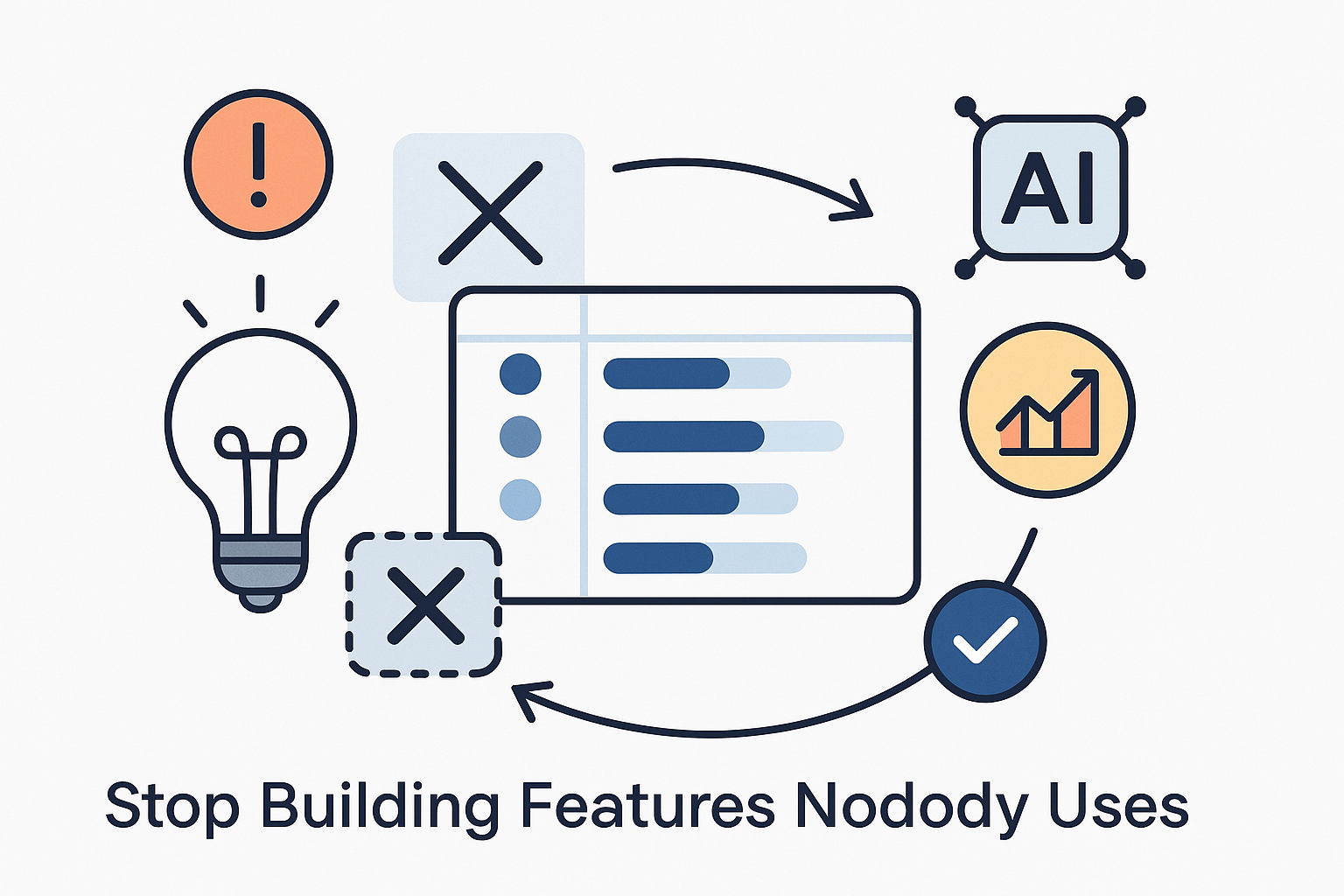
You spent three weeks on a feature. Design reviews, a migration, a polished settings panel. You shipped it. Then you opened the analytics and saw the adoption line crawl along the floor. Nobody asked for the thing you just spent a sprint on, and the thing five customers actually begged for is still sitting in row 40 of a spreadsheet you stopped looking at in November.
This is the quiet tax on most roadmaps. Pendo's research found that roughly 80% of software features are rarely or never used. The work gets done. The value doesn't show up. And the reason is almost always the same: the roadmap was sorted by whoever talked loudest, what was easiest to build, or a gut feeling dressed up as a 2x2 matrix.
The honest fix is a scoring system — real impact, real effort, a real ranking. But building that system has always been its own project. Columns to design, formulas to wire, hypotheses to write, data to chase down. Most people never finish setting it up, so they go back to guessing.
You don't build the prioritization system. You describe it.
Here's what changed in Dotallio. You no longer open a blank board and start adding columns by hand. You open the chat and say what you want in plain language. Dotallio builds the board, picks the right column types, drops in sample rows so you can see the shape, and sets up the views. The scoring system you've been meaning to build for two years exists in about a minute.
And everything it makes is a versionable, editable artifact — the board, the docs, the charts, the workflow. You can edit any version, roll a change back, and share it with the team. You describe it, Dotallio assembles it, and then it stays alive as your thinking sharpens.
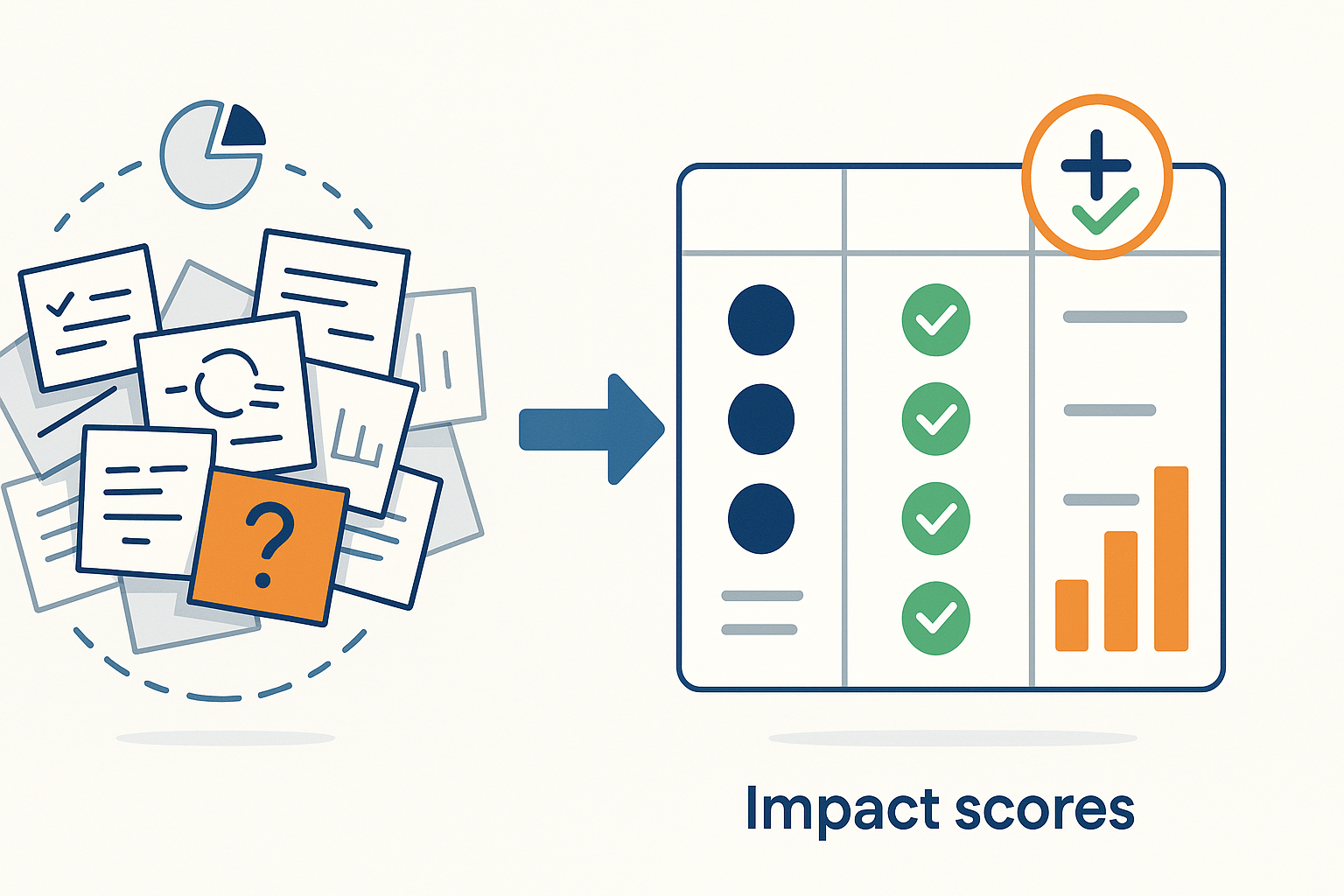
A real session: from messy backlog to ranked roadmap
Let's actually do it. Here's the kind of thing you'd type.
Create a feature prioritization board for my SaaS. Columns for feature name, the problem it solves, the customer segment, a reach estimate (how many users it touches), an impact score 1–5, a confidence score 1–5, an effort estimate in dev-days, and a status. Add 8 realistic sample features so I can see how it works.
Dotallio builds the board: a single-select for status, number columns for reach, impact, confidence and effort, a long-text column for the problem statement, and eight sample rows you can immediately edit or delete. No column-type menus, no setup wizard.
Now you want the actual math, not just raw numbers. RICE is the classic: Reach × Impact × Confidence, divided by Effort. You don't write the formula syntax — you describe the rule.
Add a "RICE Score" formula column: reach times impact times confidence, divided by effort. Then sort the board by it, highest first.
Dotallio writes the formula in Google Sheets syntax — the same =({Reach}*{Impact}*{Confidence})/{Effort} you'd write in a spreadsheet — and adds a sorted view so your highest-leverage work floats to the top automatically. Change any input and the rank re-sorts itself.
Your backlog probably doesn't live in Dotallio yet, though. It lives in a CSV export, a Notion dump, or a wall of Slack messages. Paste it in.
Here are 30 feature requests from the last quarter [paste]. Add them as rows and draft an impact hypothesis for each one based on the problem it solves.
The messy paste becomes structured rows, and an AI-filled column drafts a one-line hypothesis for each — "Bulk CSV export likely raises activation for data-heavy accounts by removing the manual re-entry step." These are starting points you tighten, not gospel. The point is you're editing real, organized rows instead of staring at a blank grid.
One more. You want a quick view of where the cheap wins are.
Make a quadrant chart plotting impact against effort, so I can see the quick wins versus the time sinks.
Dotallio generates the chart as an artifact you can drop into a doc or a deck. High-impact, low-effort features sit in the corner you actually want to look at on Monday morning.
Keeping the roadmap honest over time
A prioritization board that's accurate for one week and stale forever is just a prettier version of the spreadsheet you abandoned. The part that keeps it useful is what runs after the initial build.
Web research, on demand. Effort and impact don't live in a vacuum. At Dotallio's higher "smart" levels, the AI plans multi-step work and runs live web research. Ask it to look into a feature you're unsure about:
Research how competitors handle bulk export and summarize the table-stakes expectations into the notes column for that row.
It plans the steps, searches, and writes a grounded summary into the row — so "confidence" stops being a number you invented and starts being a number you can defend.
Bulk enrichment. When you import 30 raw requests, you don't fill 30 hypothesis cells by hand. A Smart Workflow can fill an entire column across every row in one pass — drafting hypotheses, tagging the customer segment, or estimating a rough effort band — so a quarter of backlog grooming collapses into one prompt.
Triggered, not unattended. You can run these on demand, fire them from a button on the board, or have a board event or an incoming webhook kick one off — for example, a new request lands from your feedback form and the workflow scores it on arrival. (These run when something triggers them, not silently on a schedule while you sleep.)
Versioned artifacts close the loop. When a feature ships, paste the post-launch numbers back in and ask Dotallio to compare predicted lift against actual. Because every artifact is version-controlled, you can look back at what you predicted in February versus what happened in April — and your scoring gets calibrated instead of staying a permanent guess.
What this looks like in practice
Maya runs product for a small B2B tool. Her backlog was the usual sprawl: exec pet projects, two competitor-parity features, and a pile of customer requests in a doc nobody re-read.
She described the board in one prompt, pasted her doc in a second, and asked for a RICE column in a third. Within the hour she had a sorted, defensible roadmap. The surprise was a "saved filter views" request she'd parked as low priority — high reach, high confidence, two dev-days of effort. It ranked above the flashy dashboard redesign the leadership team had been pushing, which scored mediocre impact against three weeks of work.
She built a quick quadrant chart, dropped it into a one-page doc with the top five ranked features, and shared the link with her team set to workspace visibility. The conversation in planning stopped being "who feels strongest about their idea" and became "the board says this, do we disagree with the inputs?" That's a much better argument to have.
Why this beats the old way
- No setup project. You describe the scoring system in a sentence; Dotallio builds the board, columns, formula, and views.
- Real math, not vibes. RICE or any custom weighting runs as a live Google Sheets formula and re-sorts the moment an input changes.
- Messy in, structured out. Paste a CSV, a Notion dump, or raw notes and it becomes ranked rows with AI-drafted hypotheses.
- Grounded confidence. On-demand web research and bulk AI enrichment back up your scores instead of leaving them as guesses.
- It stays alive. Versioned artifacts let you compare predicted versus actual after launch, so next quarter's prioritization is sharper.
Build the thing that moves the needle
You don't have unlimited sprints, and you definitely don't have sprints to spare on features that land with a thud. Stop sorting your roadmap by whoever's loudest and start sorting it by real, comparable impact — without spending a day building the system that does the sorting.
Describe your prioritization board, paste in your backlog, and let Dotallio assemble the ranked roadmap with you. Then keep it honest as you ship.
Try Dotallio Free and turn your backlog into a ranked, defensible roadmap in an afternoon.